
Whether organisations are already outsourcing some or part of their operations or are looking to outsource, there are a series of challenges in searching for the right outsourcing supplier and then managing the ongoing partnership. Below are the findings of the roundtables we conducted at the CCMA’s Contact Centre Outsourcing Summit that we supported.
We also powered CCMA’s UK Contact Centre Outsourcing Report 2024 which breaks down the UK contact centre outsourcing landscape and serves as your essential guide for forming successful outsourcing partnerships. You can request the report here.
Searching for the right outsourcing partner
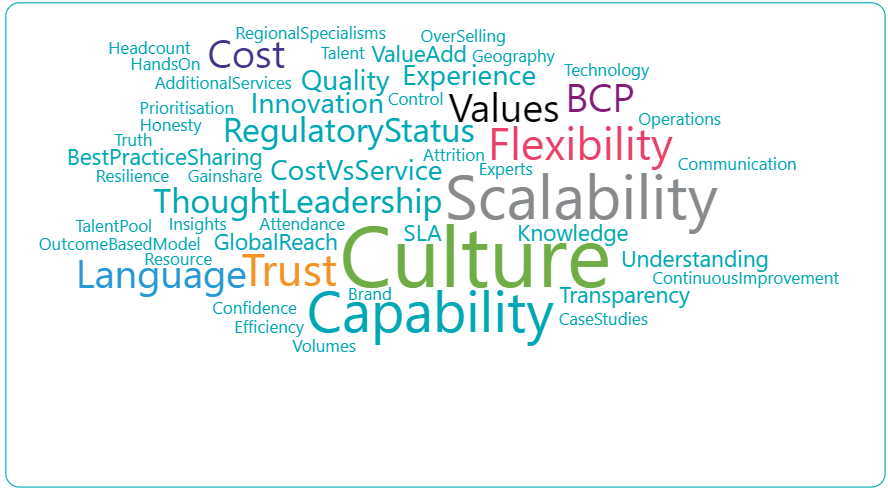
Three of the main challenges in the pre-award stages are culture, flexibility and cost.
From our discussions, we understand that buyers are consistently facing challenges related to culture. When searching for the right outsourcer, buyers have concerns around finding a partner who aligns with their own brand, purpose and values. They are looking to form a successful partnership with an organisation, which is built on more than them purely being viewed as a service provider, and instead becomes and behaves as an extension of their brand. Some of the other barriers include an outsourcers language capabilities or knowledge of the products, services and sector. Equally, the management team of a provider is seen as exceptionally crucial for building the partnership, with buyers looking for expertise and knowledge. Without the ability to connect on a cultural level, this often hinders the establishment of trust and understanding in the partnership.
Buyers also discussed the challenge of a BPOs ability to be flexible and agile. There is often a concern that buyers are putting their trust in the technical capabilities of a partner to handle complex queries and show that they are able to respond effectively to fluctuations in demand and changing requirements. Buyers are looking for outsourcers who are innovative and demonstrate value-add beyond the basic contractual and commercial terms. They seek partners who drive change, excellent service levels and effective service delivery. For many organisations, their outsourcing partner is handling the majority of, and in some cases, all of their customer interactions. Therefore, demonstrating proactivity in sharing best practice, understanding their customers‘ needs and encouraging thought leadership, is crucial for the partnership.
Unsurprisingly, one of the key challenges in the pre-award stage is around cost. Buyers want to know that what they are signing up to commercially is actually what is going to be delivered throughout the course of the partnership. Many organisations across the sector are facing challenges when it comes to budgets and forecasting, and therefore the buyer needs to know where they are spending their money and that it is delivering value. What‘s important, is that it‘s not just about an outsourcer trying to offer the lowest price to obtain the contract from the buyer; but instead, is about demonstrating the value the partner can add and where they can provide efficiencies. Another key part of this, is the choices involved in a BPO‘s geographic location. While there are clearly cost savings choosing one location over another, both on and offshore, it‘s crucial for the buyer to ensure that the geography they choose to outsource to has a strong understanding of their brand, sector and can provide a quality service. Therefore, buyers are looking beyond the basic cost metrics, and are really searching for the added value a partner can provide.
What‘s clear from our discussions, is that buyers are looking to take the time in the sourcing process to understand that the outsourcer is going to be able to deliver on their promises. Three of the most important elements of this are cultural alignment, demonstration of flexibility, and value-adding in terms of cost, alongside scalability, best practice sharing and innovation.
Working with an outsourcing partner
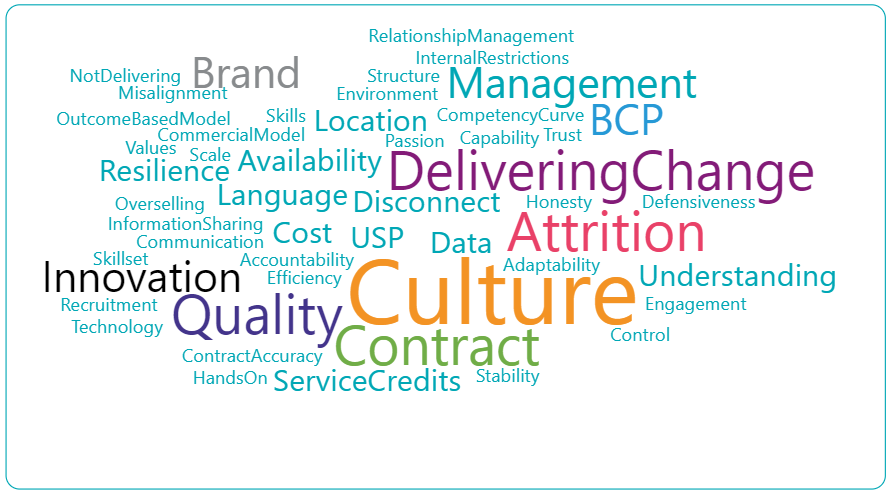
Three of the main challenges in the post-award stages are quality, attrition and delivering change.
During our discussions, attendees highlighted that quality is a core challenge when working with outsourcers. The main concerns revolve around ensuring that a partner can provide excellent customer service and experience – whether that is through the technology they deploy or driving change and improvement. Buyers place significant value on strong communication at both an operational and performance level, holding their partners to account for expertise in delivering successful outcomes for their customers. It is recognised that there are sometimes barriers from both sides of the partnership of not sharing information effectively, which can negatively impact a partners ability to innovate. Therefore, it is vital to ensure that quality has been discussed and performance is being measured from the outset.
The second challenge in the post-award stage is culture and in particular, the impact of attrition. Across all levels of the organisation, buyers are looking for partners to ensure that they are recruiting the right people with the right skillset, as ultimately this impacts service continuity and the ability to understand customer needs. A key part of this is around building a stable environment. Buyers are concerned about the impact attrition and churn can have on the end customer’s experience. Moreover, it is not only perceived as a high driver of costs, but also as a barrier to being able build trust between the buyer and the outsourcer. This concern around people management is not solely seen as impacting the choice of frontline colleagues, but also the top levels of management. The formation of strong partnerships between the management and leadership team between the buyer and outsourcer is seen as a crucial. Buyers wish to ensure that there is open and honest communication, with a willingness to demonstrate accountability if there are challenges or errors. There is often a misalignment in the expectations that were set out in the formation of the partnership, and this can have considerably damaging impacts. Therefore, buyers want to take the time to build and establish a strong relationship based on transparency and trust and know that they can rely on their partner to tackle staffing challenges proactively.
The final core challenge that buyers are experiencing is around delivering change. In today’s market, buyers are looking to diversify and streamline customer interactions, and therefore are reliant on partners to champion best practice in this area. With such high levels of competition across the customer experience market and the need to respond to customers effectively and quickly, access to new technologies and digital transformation is imperative. Buyers want outsourcers to drive innovation and be champions of change in this evolution. However, they are coming up against challenges in accessing efficiencies and speed to competence when working with partners. In the cases where technology is being presented as an outsourcers USP and was part of the rationale for choosing the partner, this can cause friction.
There are clearly other challenges that impact the success of a partnership and these are highly dependent on the size and scale of the outsourcer, the requirements and needs of the buyer, and at what point in the partnership in terms of timescale these challenges have arisen. What is clear, is that buyers are seeking out partners who tackle challenges head-on, to demonstrate proactivity in their approach and show agility in responding to changing needs. Ensuring effective communication and evidence-based decision making will support with the establishment of a successful, lasting partnership.
About the Author
 Spencer Brooks, Co-Founder & CEO, The Knowledge Group (tkg)
Spencer has worked in the BPO sector for +25 years. With an accounting background, Spencer has been part of some of the industry’s most innovative commercial arrangements in the BPO Market. From this platform, Spencer has worked both buyer and sales side of the procurement line, using this knowledge to establish The Knowledge Group (tkg). The Knowledge Group is a disruptive sourcing and procurement firm, specialising in delivering outsourcing solutions for clients. Recently, The Knowledge Group merged with Maistro, a procurement technology service provider. Together, the organisations are aligned in connecting buyers to suppliers, harnessing a combination of powerful digital solutions and industry expertise.



Supported by


Not a member?
For details on membership packages and benefits click here.
Join today and get immediate access to member benefits.
Stay close to the CCMA by signing up today and find out about ...
- Visits to award-winning contact centres
- Latest industry insights
- Upcoming events
- Industry news