Supported by

So, it’s worth asking the question that’s being directed towards the contact centre industry: do customers really prefer speaking to chatbots as opposed to humans? Unsurprisingly, the answer is more nuanced than the question demands.
The CCMA’s 2026 research paper Beyond Demographics: Customer Contact Personas Shaping UK Service Expectations draws on a nationally representative survey of 2,000 UK adults to uncover the contact preferences, technology attitudes and experience-sharing behaviours that define UK consumers – while also identifying five distinct ‘Customer Contact Personas’.
Acceptance of chatbots and AI among the surveyed consumers forms a key part of the research study, but the answer to whether or not they want to actually use them is very much – “it depends”. It depends on what they needs help with, it depends on who they are, and it depends how much they trust the technology on the other end of the conversation.
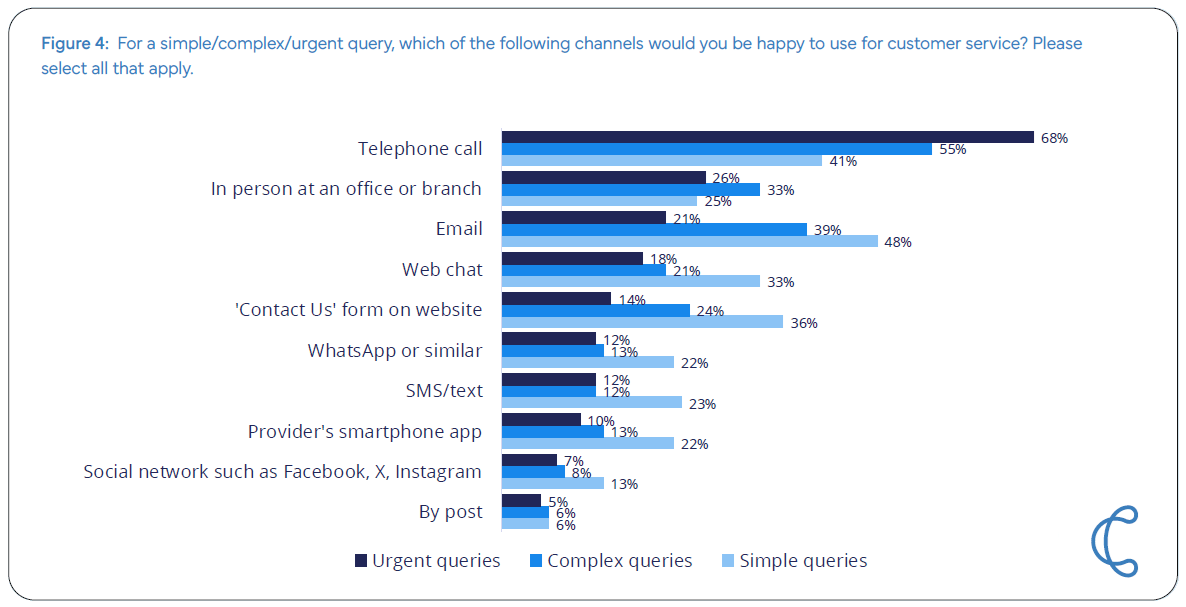
Starting with the nature of the contact is always key. When queries are simple – changing a password, checking a delivery – our research shows that customers are, broadly speaking, becoming more and more comfortable with digital-first channels such as chatbots. Email tops the list, ahead of phone.
However, that comfort shrinks fast as the stakes rise. For complex queries, phone overtakes every digital channel. For urgent queries – a suspected fraud, a broken boiler – phone becomes the overwhelming default, chosen by more than two-thirds of people. Chatbots, in other words, may be winning the easy stuff, but they’re still a much harder sell when something’s gone wrong and someone’s got a challenging or urgent need.
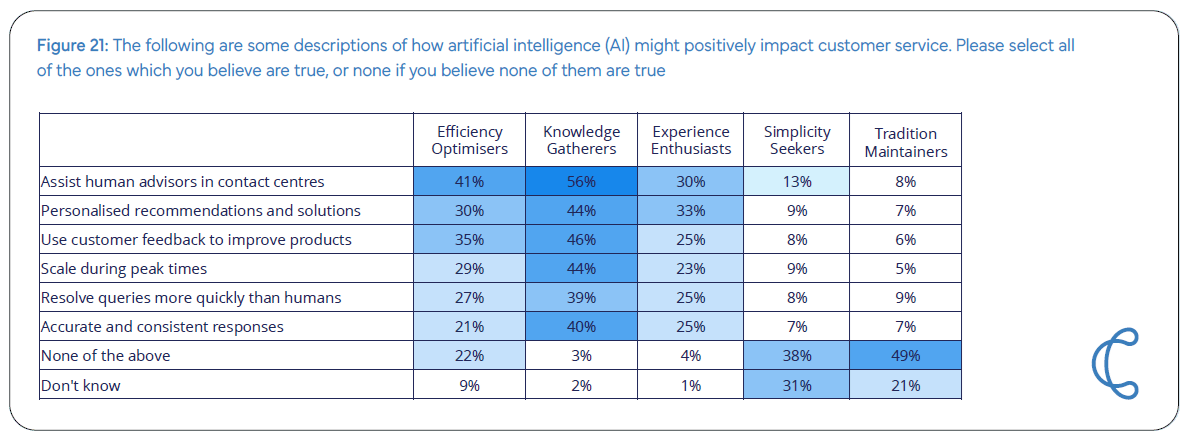
As stated, the research identifies five distinct Customer Contact Personas, and their appetite for AI and automation varies enormously.
‘Knowledge Gatherers’ – predominantly younger, tech-confident, high earners – are the most likely of all personas to see real benefit in AI, from faster resolutions to smarter recommendations.
At the other end of the scale, ‘Tradition Maintainers’ are considerably more sceptical, with roughly half rejecting the idea that AI brings any benefit at all.
Treating the customer as one homogenous group with one homogenous preference is where issues can lie for some organisations. As the research highlights, it’s becoming more and more important to acknowledge that ‘we are not all the same’, and that choice and contextual understanding form the backbone to establishing what the human and AI mix within the contact centre should look like.
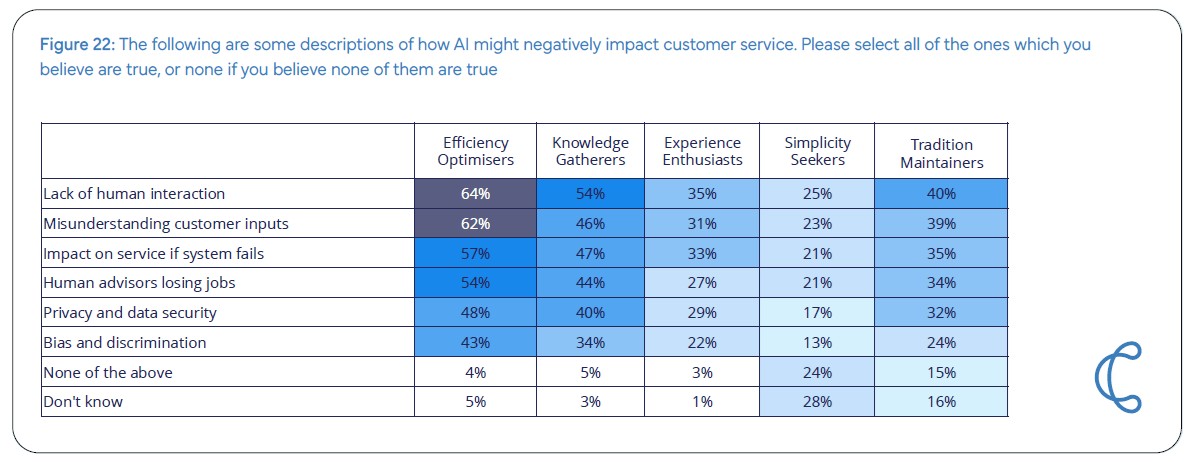
Any consumer scepticism around newer technologies isn’t just about capability, it’s about trust. Our research finds that across the board, meaningful proportions of customers associate AI with tangible risk: worries about losing human interaction altogether, AIs misunderstanding what they’re actually asking, or being left stranded if the system fails.
Even among the most digitally confident of the five Customer Contact Personas, these concerns don’t disappear, they’re just outweighed by perceived convenience. Among the most sceptical personas, they dominate.
The Beyond Demographics research doesn’t support a blanket claim about chatbot and AI preferences in either direction – but the fact that trust in AI remains genuinely fragile for a significant slice of the population is not a minor footnote.
One vital component of any customer-facing AI and automation is increasingly becoming the handoff: i.e. the moment a chatbot hands over to a human. Research shows that getting that wrong, for instnace making someone repeat themselves or leaving no route to a person when they need one, is often what erodes trust in automation altogether, regardless of how well the technology performed up to that point. Any organisation reshaping its contact strategy around AI has to consider the design of its handoffs as deliberately as the automation itself, knowing that trust is one of the hardest things to win back with customers, once it’s lost.
Read the Good Practice Guide: Designing Handoffs – When and How to Escalate an Automated Interaction to An Advisor
Read the CCMA’s 2026 research paper: Beyond Demographics: Customer Contact Personas Shaping UK Service Expectations
As Head of Content, Chris works closely with the CCMA team and the contact centre community to ensure members receive the most relevant, timely and engaging content about their industry. Prior to working with the CCMA, Chris was a seasoned business journalist – this included nine years writing about trends in the CX and contact centre space for former industry publication, MyCustomer.

By completing this form you agree to the CCMA using your personal data in accordance with our Privacy Policy. We use your data to personalise and improve your experience on our digital platforms, send you relevant communications, provide products and services you request from us, and to carry out profiling and market research. You have the right to object, unsubscribe or be deleted from our database. Please contact info@ccma.org.uk.