

The 2026 edition of our Voice of the Contact Centre Consumer research reveals that for the first time in five years, more UK consumers feel customer service has improved than feel it has worsened.
The research finds that 31% of UK consumers now feel customer service has improved over the past 12 months, while just 26% feel it has worsened. That’s a reversal of the position in 2024, when the net sentiment was ten percentage points negative.
Travel providers (+20 net) and banks (+18 net) are leading the way, while positive sentiment is most prevalent among younger demographics and the more affluent.
Consumer acceptance of self-service is also growing, with willingness to self-serve rising sharply for simple queries such as routine technical support (+14) and opening a new account (+9).
For contact centre leaders, these numbers reflect the genuine progress of recent years, and that the sustained investment in people, technology and digital experience is being noticed by the public.
However, the same research tells a second story, and it’s one that demands attention.
Vulnerable Consumers Feel Left Behind
Despite the positive trending, the research also finds that improvement in sentiment is not shared equally across the population. Vulnerable consumers – those who are financially vulnerable, health vulnerable, carrying caring responsibilities, or navigating significant life events – continue to experience customer contact differently, and often with greater difficulty, than the wider population.
Financially vulnerable consumers are significantly less likely than non-vulnerable consumers to report that customer service has improved (21% vs 32%), and more likely to say it has worsened (31% vs 25%).
63% of those with carer responsibilities and 54% of the financially vulnerable feel their personal circumstances make them more likely to be treated unfairly by organisations.
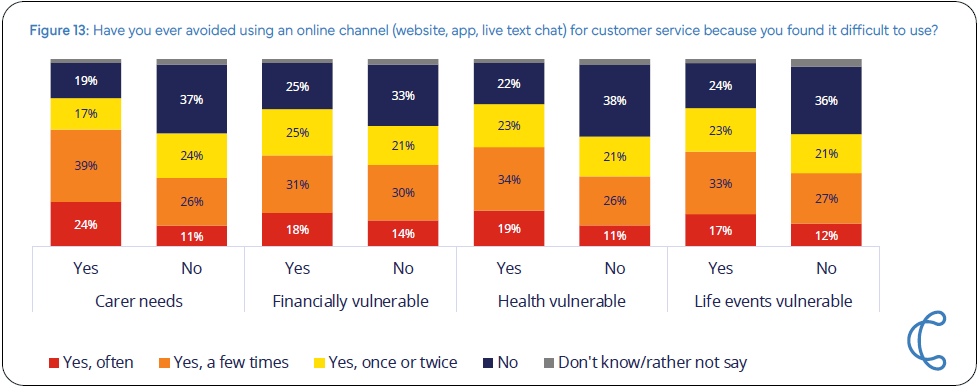
The digital divide is just as pronounced, with 80% of those with carer needs and 76% of the health vulnerable report having avoided online customer service channels because they found them difficult to use.
And while overall self-serve failure rates are beginning to improve, vulnerable consumers continue to fail at higher rates than their non-vulnerable counterparts – meaning the gains in digital experience have not yet translated equally across the population.
Closing the Gap is an Important Industry Challenge
Our Voice of the Contact Centre Consumer makes it clear that the work of the next 12 months is not just about continuing the progress that has been made – it’s about ensuring that progress reaches everyone.
Vulnerable customers are the most at risk when contacting organisations in moments of stress – whether it’s about bills they cannot pay or support and services they need to access. These are interactions that define how people feel about the organisations that serve them, and they are the ones least well served by the current trajectory.
Peter Connolly, Head of Operations, Legal and General was one of a number of contact centre leaders to share their views for the research about how the contact centre industry is responding to some of the trends evaluated, including improving experiences for vulnerable customers.
“Huge amounts of training go into additional support and sensitive customer engagements such as bereavement,” he said. “But there is still a gap in terms of understanding what best practice looks like and who is genuinely doing vulnerability work well.
“How you join the dots between different channels, different interactions and different kinds of information disclosure is key.”
Contact centre leaders at organisations including United Utilities, Camden Council, Willis Towers Watson and Diabetes UK also shared their insights with us as part of the research – discussing how their teams are already working to recognise vulnerability earlier, design more flexible journeys, and ensure the route to a human is always available when it’s needed.
Their contributions are a reminder that the sentiment gap is something that contact centre leaders are already working hard to solve, but also continues to evolve. The frameworks, the technologies and the practices all exist, but the question is how industry leaders are able to apply them to the customers who stand to benefit most.
The full Voice of the Contact Centre Consumer 2026 report is available now.
Download it here to read the findings in detail.



Supported by


Not a member?
For details on membership packages and benefits click here.
Join today and get immediate access to member benefits.

Stay close to the CCMA by signing up today and find out about ...
- Visits to award-winning contact centres
- Latest industry insights
- Upcoming events
- Industry news